Condensation
Condensation methods can be used to reduce the number of degress of freedom (dof). The condensated dofs should not be updated and therefore no fracture or non-linear behavior should exist in this region. In theory it is possible, but it leads to continuous update of this region and is inefficient.
Guyan Condensation
The system is partitioned into slave $s$ and master $m$ dof [13]:
\[\begin{equation}\begin{bmatrix} \mathbf{K}_{mm} & \mathbf{K}_{ms} \\ \mathbf{K}_{sm} & \mathbf{K}_{ss} \end{bmatrix} \begin{bmatrix} \mathbf{u}_m \\ \mathbf{u}_s \end{bmatrix} = \begin{bmatrix} \mathbf{F}_m \\ \mathbf{0} \end{bmatrix} \end{equation}\]
Since $\mathbf{F}_s = \mathbf{0}$, the second block row gives:
\[\begin{equation} \mathbf{K}_{sm}\mathbf{u}_m + \mathbf{K}_{ss}\mathbf{u}_s = \mathbf{0} \quad\Rightarrow\quad \mathbf{u}_s = \mathbf{T}\,\mathbf{u}_m, \qquad \mathbf{T} = -\mathbf{K}_{ss}^{-1}\mathbf{K}_{sm} \end{equation}\]
Substituting into the first block row yields:
\[\begin{equation} \mathbf{K}_{mm}\mathbf{u}_m + \mathbf{K}_{ms}\mathbf{T}\mathbf{u}_m = \mathbf{F}_m \end{equation}\]
which defines the condensed system $\hat{\mathbf{K}}_{mm}\,\mathbf{u}_m = \mathbf{F}_m$ with the condensed stiffness matrix:
\[\begin{equation} \hat{\mathbf{K}}_{mm} = \mathbf{K}_{mm} - \mathbf{K}_{ms}\mathbf{K}_{ss}^{-1}\mathbf{K}_{sm} = \mathbf{K}_{mm} - \mathbf{K}_{ms}\mathbf{T} \end{equation}\]
Following Guyan [13] for dynamic problems, the mass matrix $\mathbf{M}$, which is diagonal in the PD discretization, is condensed analogously using the same transformation $\mathbf{T}$:
\[\begin{equation} \hat{\mathbf{M}}_{mm} = \mathbf{M}_{mm} + \mathbf{T}^T\mathbf{M}_{ss}\mathbf{T} \end{equation}\]
where $\mathbf{M}_{mm}$ and $\mathbf{M}_{ss}$ are the diagonal mass submatrices of the master and slave partitions, respectively. The product $\mathbf{T}^T\mathbf{M}_{ss}\mathbf{T}$ introduces off-diagonal coupling, so $\hat{\mathbf{M}}_{mm}$ is generally full. The condensed dynamic system is:
\[\begin{equation} \hat{\mathbf{M}}_{mm}\ddot{\mathbf{u}}_m + \hat{\mathbf{K}}_{mm}\,\mathbf{u}_m = \mathbf{F}_m \end{equation}\]
Several limitations apply. The factorization of $\mathbf{K}_{ss}$ is a one-time preprocessing cost, amortized over all load steps but potentially significant for very large $\Omega_s$. More importantly, $\mathbf{T}$ is computed once from the initial stiffness, so $\Omega_s$ must remain linear elastic and undamaged throughout the simulation. Finally, inertial effects in $\Omega_s$ are neglected; high-frequency waves impinging on the $\Omega_s$/$\Omega_m$ interface are partially reflected rather than correctly transmitted, restricting the approach to quasi-static or low-frequency dynamic fracture problems.
PD–Matrix Coupling within $\Omega_m$
No PD bond may reach into $\Omega_s$, which is enforced by requiring $\Omega_c$ to be at least one horizon $\delta$ wide around $\Omega_p$:
\[\mathcal{H}_i \subseteq \Omega_m = \Omega_c \cup \Omega_p \quad \forall\, i \in \Omega_p\]
If you use model reduction the active part is the point wise method [11]. Fracture can easily be implemented. The equation shows how it works. You have regions $cc$ which includes all matrix parts. In the case of reduced models the active and condensed nodes (.)^c. This region couples in the material point region $pc$ and $cp$. If you want to ''cut'' parts of the matrix you have to delete the $pc$ and $cp$ parts of the material point method $(.)^p$.
\[\begin{bmatrix} \mathbf{f}_c \\ \mathbf{f}_p \end{bmatrix} = \underbrace{ \begin{bmatrix} \hat{\mathbf{K}}_{cc} & \hat{\mathbf{K}}^{c}_{cp}+\hat{\mathbf{K}}^{p}_{cp} \\ \hat{\mathbf{K}}^{c}_{pc}+\hat{\mathbf{K}}^{p}_{pc} & \hat{\mathbf{K}}_{pp} \end{bmatrix} \begin{bmatrix} \mathbf{u}_c \\ \mathbf{u}_p \end{bmatrix} }_{\text{Matrix part}} + \underbrace{ \begin{bmatrix} \mathbf{f}_c^{\mathrm{pd}} \\ \mathbf{f}_p^{\mathrm{pd}} \end{bmatrix} }_{\text{Material point part}}\]
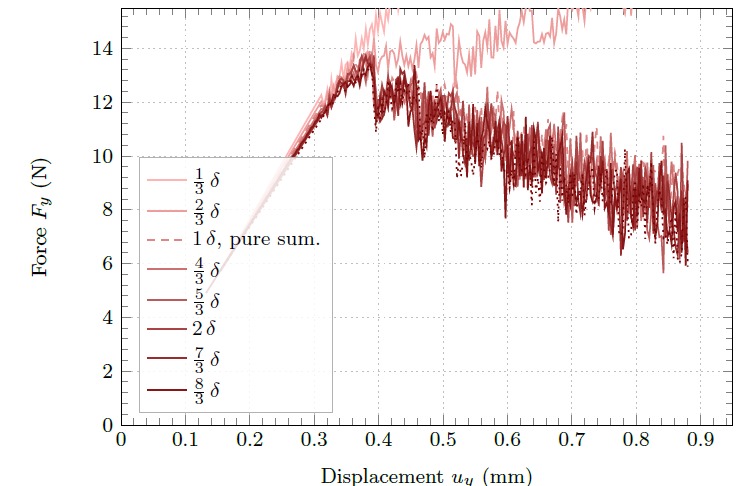
where $\hat{\mathbf{K}}^{p}_{cp}=\hat{\mathbf{K}}^{p}_{pc}=\hat{\mathbf{K}}_{pp}=\mathbf{0}$ by construction. The distance to the reduced nodes is large enough. The figure shows that $2\delta$ should be at least the distance from the fracture.

- Slave nodes (red, $\Omega_s$): Far-field region, condensed out. Must remain linear elastic, undamaged, and carry no external loads.
- Matrix nodes (light blue, $\Omega_c \subset \Omega_m$): Solved via the stiffness matrix. Captures load introduction, boundary conditions, and correct stiffness distributions. Must remain undamaged.
- PD nodes (blue, $\Omega_p \subset \Omega_m$): Damage region. Bond forces are evaluated via the material point formulation at each time step.
Craig Bampton condensation
Guyan condensation carries the mass of the slave region through $\mathbf{T}^T\mathbf{M}_{ss}\mathbf{T}$, but admits no deformation of $\Omega_s$ other than the static one prescribed by $\mathbf{T}$. The slave region contributes inertia without deformation modes of its own, which introduces errors at higher frequencies. Craig-Bampton condensation [14] retains the static relation and adds those modes.
The partitioning into slave $s$ and master $m$ dof is the one used above. The displacement field is expressed through two sets of shape functions:
\[\begin{equation} \begin{bmatrix} \mathbf{u}_m \\ \mathbf{u}_s \end{bmatrix} = \underbrace{\begin{bmatrix} \mathbf{I} & \mathbf{0} \\ \boldsymbol{\Phi}_c & \boldsymbol{\Phi}_n \end{bmatrix}}_{\mathbf{T}} \begin{bmatrix} \mathbf{u}_m \\ \boldsymbol{\eta} \end{bmatrix} \end{equation}\]
The constraint modes $\boldsymbol{\Phi}_c = -\mathbf{K}_{ss}^{-1}\mathbf{K}_{sm}$ are the static response of $\Omega_s$ to a unit displacement of each master dof and are identical to the Guyan transformation. The fixed-interface normal modes $\boldsymbol{\Phi}_n$ follow from the eigenvalue problem of the slave region with all master dof held fixed:
\[\begin{equation} \mathbf{K}_{ss}\boldsymbol{\Phi}_n = \mathbf{M}_{ss}\boldsymbol{\Phi}_n\boldsymbol{\Lambda}, \qquad \boldsymbol{\Lambda} = \mathrm{diag}(\omega_1^2,\dots,\omega_{n}^2) \end{equation}\]
Only the $n$ lowest modes are retained; the modal amplitudes $\boldsymbol{\eta}$ are not displacements. Mass normalisation of the modes,
\[\begin{equation} \boldsymbol{\Phi}_n^T\mathbf{M}_{ss}\boldsymbol{\Phi}_n = \mathbf{I}, \qquad \boldsymbol{\Phi}_n^T\mathbf{K}_{ss}\boldsymbol{\Phi}_n = \boldsymbol{\Lambda} \end{equation}\]
determines the structure of the reduced matrices $\hat{\mathbf{K}} = \mathbf{T}^T\mathbf{K}\mathbf{T}$ and $\hat{\mathbf{M}} = \mathbf{T}^T\mathbf{M}\mathbf{T}$:
\[\begin{equation} \hat{\mathbf{K}} = \begin{bmatrix} \hat{\mathbf{K}}_{mm} & \mathbf{0} \\ \mathbf{0} & \boldsymbol{\Lambda} \end{bmatrix}, \qquad \hat{\mathbf{M}} = \begin{bmatrix} \hat{\mathbf{M}}_{mm} & \boldsymbol{\Phi}_c^T\mathbf{M}_{ss}\boldsymbol{\Phi}_n \\ \boldsymbol{\Phi}_n^T\mathbf{M}_{ss}\boldsymbol{\Phi}_c & \mathbf{I} \end{bmatrix} \end{equation}\]
The blocks $\hat{\mathbf{K}}_{mm}$ and $\hat{\mathbf{M}}_{mm}$ are those of the Guyan reduction; setting $n = 0$ removes the modal block and recovers it exactly. The off-diagonal blocks of $\hat{\mathbf{K}}$ vanish because $\mathbf{K}_{ss}\boldsymbol{\Phi}_c = -\mathbf{K}_{sm}$ makes the contributions $\mathbf{K}_{ms}\boldsymbol{\Phi}_n$ and $\boldsymbol{\Phi}_c^T\mathbf{K}_{ss}\boldsymbol{\Phi}_n$ cancel: constraint modes and fixed-interface modes are $\mathbf{K}$-orthogonal. The mass exhibits no such cancellation, so both parts remain coupled through inertia. The condensed system reads:
\[\begin{equation} \hat{\mathbf{M}} \begin{bmatrix} \ddot{\mathbf{u}}_m \\ \ddot{\boldsymbol{\eta}} \end{bmatrix} + \hat{\mathbf{K}} \begin{bmatrix} \mathbf{u}_m \\ \boldsymbol{\eta} \end{bmatrix} = \begin{bmatrix} \mathbf{F}_m \\ \mathbf{0} \end{bmatrix} \end{equation}\]
It has $n_m + n$ dof. Boundary conditions and external loads act on the $n_m$ physical master dof; the $n$ modal amplitudes are integrated alongside them. Loads on slave dof would require the projection $\mathbf{F}_\eta = \boldsymbol{\Phi}_n^T\mathbf{F}_s$ and are not supported.
\[\Omega_s\]
must remain linear elastic and undamaged, since $\boldsymbol{\Phi}_c$ and $\boldsymbol{\Phi}_n$ are computed once from the initial stiffness. The eigenvalue problem adds to the preprocessing cost of the factorization of $\mathbf{K}_{ss}$. In return, waves crossing the $\Omega_s$/$\Omega_m$ interface are transmitted correctly up to approximately $\omega_n$; above that frequency they are reflected.